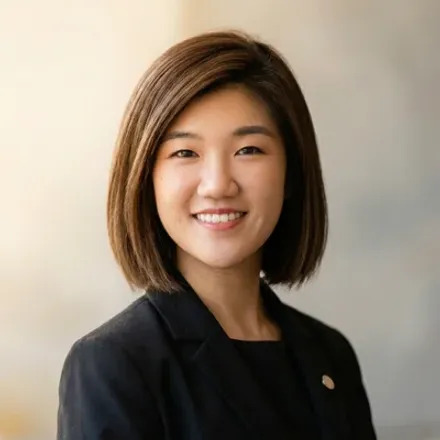
Alina Zixie Yang, B.B.A., M.T., OCT
Ontario Certified Teacher, curriculum designer, and educational strategist.
| Instructor | Alina Zixie Yang — B.B.A., M.T., OCT |
|---|---|
| Certification | Ontario College of Teachers, member in good standing |
| Qualifications | Intermediate/Senior — mathematics, business studies |
| Education | University of Toronto — B.B.A. (Scarborough) · Master of Teaching (OISE) |
| Practice | Ontario public secondary classroom; multi-campus STEM programs |
| Languages | English · Mandarin · Cantonese · Japanese |
| Enquiries | hello@alinayang.ca |
Section 1 — Biography
Who is teaching this
Alina Yang teaches secondary school with the Toronto District School Board and holds certification with the Ontario College of Teachers (OCT) in the Intermediate/Senior divisions, with mathematics and business studies as her teachables. She completed her Bachelor of Business Administration at the University of Toronto Scarborough and her Master of Teaching at OISE — a combination that shapes how she works: classroom practice grounded in research, delivered with the discipline of a well-run organization.
She has been teaching since 2017, and in more rooms than any one subject would suggest: senior mathematics at a Toronto supplementary school, K–12 mathematics tutoring, grade 8 Mandarin, Cantonese language and culture, and — from March 2020 — coding in CoffeeScript and Python, online, for Caution Tape Robotics. Working across languages and age groups is part of why her planning starts with who is in the room rather than with the content.
As Director of Education at Caution Tape Robotics, Alina is responsible for educational strategy and teacher development. That means setting the standards a lesson has to meet before it reaches a student, building the curriculum that gets it there, and training the instructors who teach it — across robotics, coding, and maker programs serving students from elementary through high school.
Her focus is the part of education that is easy to skip: making sure a program is coherent from one week to the next, that instructors know exactly what they are teaching and why, and that what students walk away with is real skill rather than a finished kit.
- Passionate
- Enthusiastic
- Respect
- Equity
- Diversity
- Inclusive
Section 2 — Teaching philosophy
What the practice commits to
Six commitments that decide what a lesson looks like, each followed by an instance of it from her own teaching record.
-
01
Start from what students can already do
A lesson that ignores prior knowledge either bores the room or loses it. Good planning begins with an honest read of where students actually are — then builds one clear step from there.
-
02
Rigour is a form of respect
Lowering the bar is not kindness. Students rise to work that is demanding and well scaffolded, and they can tell the difference between a hard task and an unfair one.
-
03
Assessment should teach, not just measure
Feedback matters more than a grade. Assessment is designed so students know what to do next, and so teachers learn whether the instruction actually landed.
-
04
Language is part of the subject
Students cannot show what they know in a subject whose language is still forming for them. Terms get spoken, used in a sentence, and checked — and the room talks about itself as "we", never as "you and I".
-
05
Design for the whole room before designing the lesson
Universal Design for Learning and backward design belong in the same pass: read the expectation, write down who is actually in the room, and only then decide what happens on the day.
-
06
A program is only as good as its instructors
Curriculum does not teach itself. Investing in teacher development — clear materials, modelling, coaching, feedback — is what makes quality consistent instead of accidental.
Section 3 — Current appointments
Where the work happens now
| Post | Organization & scope |
|---|---|
| Secondary Mathematics Teacher Present | Lester B. Pearson Collegiate Institute, Toronto District School Board Classroom teaching in an Ontario public secondary school, working within the Ontario curriculum and its assessment and evaluation policy. Currently teaching MCR3U — Functions, Grade 11, University Preparation.
|
| Director of Education Present · with the organization since 2020 | Caution Tape Robotics Owns educational strategy and teacher development across robotics, coding, and maker programs. Joined in March 2020 as an online coding instructor teaching CoffeeScript and Python.
|
Section 4 — Education & certification
Qualifications on file
| Credential | Granting body & detail | Years |
|---|---|---|
| Ontario Certified Teacher (OCT) | Ontario College of Teachers Certified member in good standing. Intermediate/Senior divisions — mathematics and business studies. | — |
| Master of Teaching (M.T.) | University of Toronto — Ontario Institute for Studies in Education Research-based teacher education leading to Ontario certification. Intermediate/Senior division, with teachables in mathematics and business studies. | 2020 – 2022 |
| Bachelor of Business Administration (B.B.A.) | University of Toronto Scarborough Specialist in general management. Exchange terms at CUHK (Hong Kong) and NUS (Singapore) on scholarship, and a summer abroad at ICU (Japan). | 2012 – 2017 |
Languages
| Mandarin | Native |
| English | Proficient |
| Cantonese | Proficient |
| Japanese | Intermediate |
Tools
- Python
- CoffeeScript
- Google Workspace for Education
- Adobe Photoshop
- Final Cut
Section 5 — Practicum
David Suzuki Secondary School
Adapted practicum through the Master of Teaching program: a school portrait case study of David Suzuki S.S., and three mathematics lessons designed and taught against the Ontario curriculum.
Lessons designed and taught
- Grade 9 de-streamed mathematics — product and quotient rules for exponents (co-taught)
- Grade 9 de-streamed mathematics — the power of a power rule (lead)
- Grade 12 mathematics — probability (facilitating)
How they were built
- Planned with backward design and Universal Design for Learning: from the curriculum expectation to the learner profiles, and only then to the day.
- Taught as a flipped, inquiry-shaped lesson — breakout groups derived the exponent rules from a problem set on a shared Jamboard before any rule was stated.
- Every material published to Google Classroom so nothing sat behind a barrier, with homework built digitally in support of the school’s sustainability initiative.
- Five formative checks inside one lesson: minds-on activity, quick review, breakout observation, a review game, and individual work.
- Reviewed by twelve Master of Teaching peers from a range of disciplines, with the lesson adapted to their VARK profiles.
Section 6 — Prior teaching
Earlier posts
Before the secondary classroom: mathematics, two languages, and coding, taught to students from kindergarten to grade 12.
| From | Role | Organization |
|---|---|---|
| 2017 | Senior mathematics teacher | T.H. Chan Memorial Math School · Toronto A class of 26 students with a wide spread of needs; weekly quizzes, worksheets, and homework packages, plus interim and final reports. |
| 2020 | Coding instructor — CoffeeScript and Python | Caution Tape Robotics · Markham Online classes designed for participation and discussion, with feedback to students and parents through Google Classroom. |
| 2019 | Mathematics tutor, K–12 | Fairview Tutoring Academy · North York Individual progress plans for students across grade levels, backgrounds, and readiness, taught concurrently. |
| 2019 | Grade 8 Mandarin teacher | Mon Sheong Foundation Chinese School · North York Monthly writing, penmanship, speaking, and reading comprehension assessment; parent feedback given in the family’s preferred language. |
| 2019 | Cantonese instructor | T.H. Chan Memorial Chinese School · Toronto Language taught through activity, with cultural and historical material built into the course and performed at community events. |
| 2015 | Study abroad program assistant | International Student Centre, University of Toronto Scarborough · Scarborough Workshops, outreach, and peer application support; coordinated 20 volunteers across campus-wide events. |
Years indicate when each post began.
Section 7 — Works cited
Reading behind the practice
Where the ideas above come from. A syllabus should say.
-
Hubert, T. L. (2014). Learners of mathematics: High school students’ perspectives of culturally relevant mathematics pedagogy. Journal of African American Studies, 18(3), 324–336.
On what a teacher’s visible confidence in a student does to that student’s confidence in themselves.
-
Wachira, P., & Mburu, J. (2019). Culturally responsive mathematics teaching and constructivism: Preparing teachers for diverse classrooms. Multicultural Learning and Teaching, 14(1), 1–8.
Socio-constructivism as the working strategy for culturally relevant and responsive pedagogy in a mathematics classroom.
-
Carsley, D., & Heath, N. L. (2018).
On colouring as a way to settle anxiety — the reason a colouring page opened a grade 7/8 class during the pandemic.
“I believe everyone can shine, and I can’t wait to see your best potentials.”
Alina Yang, OCT